
Best Budget Air Purifier
Why Indoor Air Quality Matters
We often forget that the air inside our homes and offices can be far more polluted than outdoor air. Common pollutants such as dust, pollen, pet dander, volatile organic compounds (VOCs), and cooking or smoke fumes accumulate if ventilation is poor. Poor indoor air quality can affect sleep, allergy symptoms, respiratory health, and overall comfort.
Having a good air purifier helps by continuously cleaning the air you breathe. It’s not a substitute for ventilation or other healthy practices, but for many people—especially those in apartments, city homes, or in regions with outdoor pollution (as is common in many urban areas, including here in Bangladesh)—an air purifier is a worthwhile investment.
When looking specifically for the best budget air purifier, the challenge is achieving acceptable performance (filtration, noise, energy use) without a premium price tag. That brings us to the next section.
What Makes a “Budget” Air Purifier Good?
Affordability vs. Performance
“Budget” doesn’t necessarily mean “cheap in every respect.” It means you’re spending less than premium models, but still getting reliable performance and build quality. The sweet spot is: a price that doesn’t break the bank + key features that deliver meaningful air cleaning.
Key Quality Metrics
When judging an air purifier’s quality, focus on these major criteria:
- Clean Air Delivery Rate (CADR): This indicates how much clean air the unit can deliver per minute (or hour). A higher CADR means the device can more quickly clean the air in a given room.
- Filtration System: At minimum, you want a multi-stage filter including a pre-filter, particle filter (ideally HEPA or near-HEPA), and activated carbon or other media for odors/VOCs.
- Coverage / Room Size: A budget device may only suit smaller rooms; you must match the room size.
- Noise Level: Especially if you run it in a bedroom or study, quiet operation matters.
- Energy Efficiency & Runtime Cost: Budget means price plus ongoing cost (power draw, filter replacement).
- Build Quality & Usability: Good controls, clear maintenance, reliable brand support.
- Maintenance / Filter Replacement Cost: Even an inexpensive unit can become costly if filters are expensive or change too often.
If a unit fails badly on one of these metrics, it may feel “cheap” in result, even if the sticker price is low. Therefore, a truly good budget air purifier balances these well.
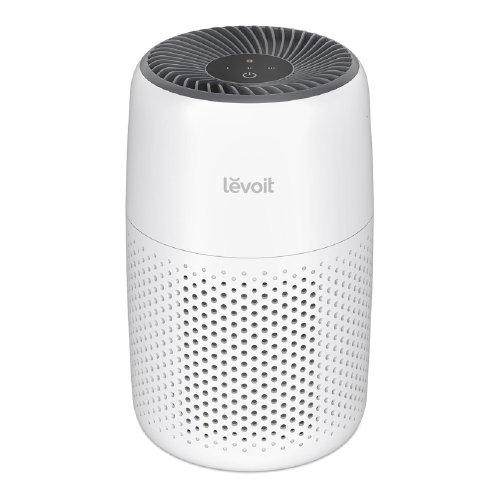
Introducing the LEVOIT Core Mini
Overview & Key Specifications
The LEVOIT Core Mini is a compact air purifier designed for smaller rooms and budget-conscious buyers. Some of its key specs:
- Dimensions approximately 6.5″ × 6.5″ × 10.4″ (≈16.4 × 16.4 × 26.4 cm) and weight around 2.2 lbs (≈1 kg).
- Uses a three-stage filtration system: pre-filter mesh, particle filter (bonded), and activated carbon layer.
- Very low power consumption: around 6-7 W at maximum speed, and standby around 1-2 W.
- Noise level reported to be about 37-44 dB in tests at various speeds.
- Ideal for small room coverage: For example, the manufacturer lists “ideal room size of 254 ft² (1 ACH) / 53 ft² (4.8 ACH)”.
- Additional “aromatherapy pad” feature: you can add essential oil drops for scent.
What Its Filtration System Offers
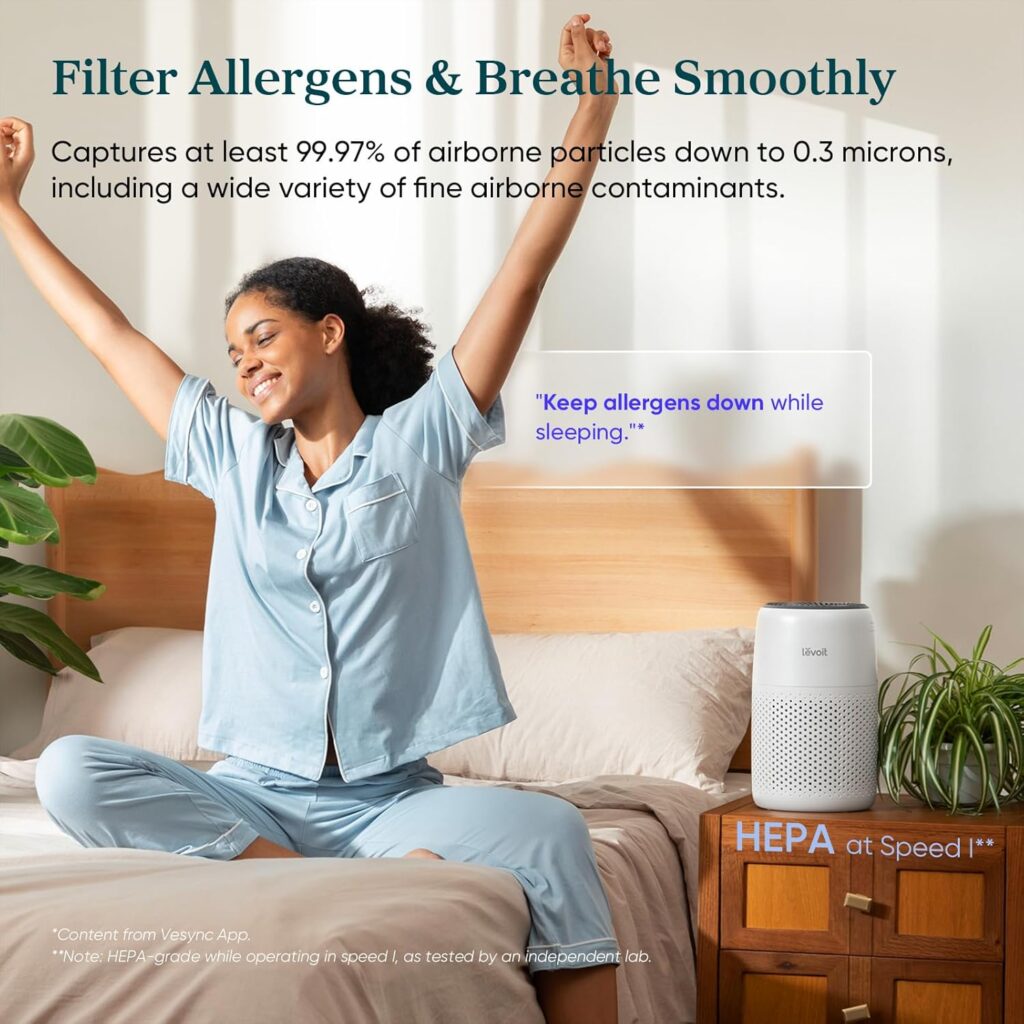
The three-stage system of the Core Mini ensures you get:
- Pre-filter: catches larger particles (dust, lint, pet hair), prolonging the life of downstream filters.
- Particle/“HEPA-like” filter: Though some reviewers note it is not a certified True HEPA (i.e., 99.97% at 0.3 microns), but removes at least 97% of particles at 0.3 microns in test conditions.
- Activated carbon layer: handles odors, cooking smells, and smoke fumes to an extent.
This means the Core Mini is built to capture particles (dust, pollen, pet dander) and reduce odors in smaller spaces. For a budget model, this is a solid set of features.
Design, Noise & Energy Efficiency
From a design perspective:
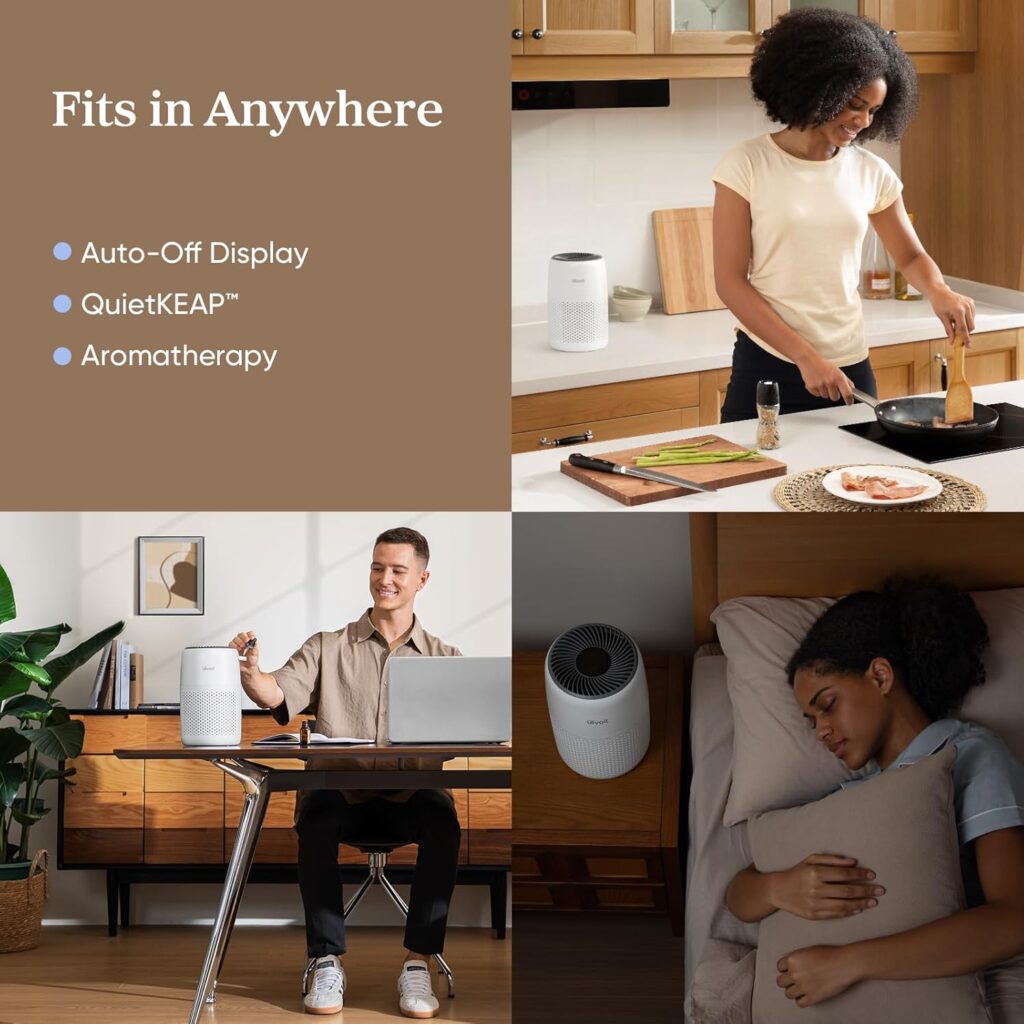
- Its compact size (10.4″ tall) means it fits easily on bedside tables, office desks, and small living spaces.
- Noise: Reviewers measured around 41.8 dBA at low fan speed, and about 53.6 dBA at high speed. For comparison, normal conversation is ~60 dBA. So this unit is relatively quiet for budget compact purifiers.
- Power draw: With only ~7 W at high speed, the running cost is very low (under $1 per month if running 24/7 at ~0.12 $/kWh in the US).
These features reinforce its “budget but quality” credentials: low cost to run, quiet enough for many settings, and minimal footprint.
In-Depth Quality Assessment
Filtration Performance and Real-World Results
It’s one thing to have good specs, another to deliver in real use. Testing reviews show that the Core Mini performed better than expected for its size. For example:
- In one test in a ~120 sq ft (~11 m²) room, the unit reduced PM2.5 from 95.3 µg/m³ down to 8.4 µg/m³ in 60 minutes at high speed.
- In a ~194 sq ft (~18 m²) room, it achieved an 89 % improvement in air quality in 60 minutes.
- The smoke box test (in a small enclosed test) had the Core Mini clear smoke in ~74 seconds—a good result given its size.
These results show that despite its very compact size and budget pricing, the device can deliver strong particulate removal in small rooms. That’s key to quality: not just good specs on paper, but proven real-world performance.
Build Quality, Materials & User Experience
From reviews:
- The housing and controls are described as straightforward and well-designed for its price point; a minimalistic cylindrical design, intuitive top-control panel.
- The filter is easy to access and replace (though it’s not washable). Reviews note the filter must be replaced every ~4-6 months under typical use.
- The aromatherapy pad is considered a useful, though not essential, bonus feature—indicating good thought in design beyond just basic filtration.
On the other hand: - Some reviewers mention the “not True HEPA” status (i.e., it may not meet the highest certification standard), which is a limitation but understandable given the budget.
- The build is solid, but the small size necessarily limits the filter volume and air-throughput compared to full-sized purifiers; hence, the coverage is for smaller rooms.
Overall, for its price and size, the build quality and user experience score high—another indicator of “good quality budget device”.
Maintenance, Filter Replacement & Long-Term Cost
Budget devices often have hidden costs (cheap filters, frequent replacement, higher noise/power). For the Core Mini:
- Filter life: approx. 4-6 months under typical use.
- Replacement filters are reasonably priced (in the budget purifier category) compared to premium models. It’s important to buy genuine filters for the best performance.
- Operating costs (power) are minimal given the low wattage (~7 W), which is excellent for continuing use.
Therefore, the long-term cost is modest, which supports its standing as a high-quality budget option.
Limitations and Where It May Not Be Ideal
Quality doesn’t mean “perfect for every scenario.” Some cautions:
- Coverage: The Core Mini is best suited for smaller rooms (e.g., bedrooms, offices). If you have a large living room or open-plan space, it may struggle to deliver adequate air changes per hour. Reviews suggest usage in small spaces only.
- Filtration certification: While it performs well, the “not True HEPA” note means that for very severe allergy/medical needs, one might choose a higher-tier unit with certified HEPA and larger CADR.
- Odor removal: Some testers felt it did less well with heavy smoke/strong odors compared to higher-priced purifiers.
- Feature set: It lacks advanced features (smart sensors, app control, auto-modes) that premium models have. If you want full “smart home” integration, you may need to move up in price.
Knowing these limitations helps you match expectations appropriately: within its niche (small room, good value), this device is strong. But for larger or specialized needs, a bigger device may be required.
Why It Qualifies as a Top Budget Option
Performance for the Price
Putting together all of the above: for a relatively modest cost, the LEVOIT Core Mini offers excellent value. It delivers strong particulate removal, decent odor handling, quiet and low-power operation, and solid build/usability—all key quality markers. Many budget purifiers compromise extensively on one of these facts (e.g., very loud, high power draw, only one-stage filtration, cheap build). This unit balances the trade-offs well.
Comparison to Other Budget Models
Based on review notes and user comments:
- On Reddit, one user commented that for a 12’×12’ room, the Core Mini might be “way too small” and suggested alternatives with higher CADR. Reddit. This underscores that size/room-match is critical.
- On broader tests, compact purifiers in the same price band often lacked as much filtration, were louder, or less energy-efficient. The Core Mini stood out in the “small room budget purifier” category.
- Some media mentions (e.g., People magazine) highlight it as “top choice for small spaces” under budget constraints.
- Thus, set against its peers in the budget range, it emerges as a high-quality option.
Using the LEVOIT Core Mini for Best Results
Ideal Placement & Room Size
- Place the purifier on a flat, firm surface (desk, bedside table, floor clear of obstructions) and avoid blocking air intake/outlet. Manufacturers and reviewers recommend leaving some clearance (e.g., 15 cm from the wall) for good airflow.
- Since it’s designed for smaller spaces (e.g., up to perhaps ~70–180 sq ft depending on fan speed and desired air changes), you’ll get the best results in a bedroom, nursery, small office, or compact living room. Targeting a larger space will reduce effectiveness unless you accept longer cleaning time or higher fan speeds (with higher noise).
Operating the Device (Fan Speeds, Settings)
- Use a higher fan speed when you first start in a room with poor air (just entered, smells, smoke, dust) to accelerate purification.
- Once air is reasonably clean (or you’re sleeping or working), switch to low or medium speed for quiet, low-power operation. Reviewers found the low speed extremely quiet (~40–42 dB), which is suitable for sleep or study.
- The aroma pad: If you wish to add a light scent, you can apply a few drops of essential oil to the pad and slide it in. This doesn’t interfere with filtration, but is more of a bonus feature—so use it if desired.
Maintenance Tips to Maximize Quality
- Regularly vacuum or clean the outside grill / pre-filter mesh (every 1-2 months) to maintain airflow and filter life. Reviews suggest doing this to prevent buildup.
- Replace the main filter when the indicator light shows or at roughly 4-6 months, depending on use and air quality. A clogged filter reduces performance and increases noise/power.
- Use the device continuously (or at least many hours daily) rather than sporadic use to maintain consistent air quality. The benefit is cumulative.
- If used in extremely dusty, smoky, or high-pollution environments, consider more frequent filter changes or higher fan speeds for initial cleaning.
- Avoid placing the unit next to heavy pollution sources (open kitchen, smokers) without adequate ventilation—though the unit helps, it’s not a substitute for source control and good ventilation.
Conclusion
If you’re searching for the best budget air purifier, especially for smaller spaces, the LEVOIT Core Mini stands out in its category. While it obviously can’t match high-end purifiers designed for large open-plan rooms, it offers exceptional value: strong filtration for particles, modest odor/ smoke handling, compact size, quiet and energy-efficient operation, and good build/usability.
Its limitations (room size coverage, no top-tier certified HEPA, simpler feature set) are clearly disclosed in reviews and are reasonable given the price. If you match it to the right room (bedroom, office, smaller living area), it delivers excellent quality for the cost.
In short: for those looking for an affordable, high-quality air purifier for personal or small-space use, the Core Mini is a top contender. Use it correctly, maintain it well, and it will significantly improve indoor air comfort and quality.
Frequently Asked Questions (FAQs)
A: It is best suited for smaller rooms—bedrooms, small offices, or compact living spaces. The manufacturer lists ideal coverage around 53 ft² at 4.8 air changes per hour, or larger at a lower air-change rate.
A: Not strictly. Some reviewers note it is not certified as “True HEPA (99.97% at 0.3 µm)”; rather, it removes at least ~97% of 0.3 µm particles in test conditions.
A: Typically, every 4-6 months under normal use, though frequent use in dusty or polluted environments may require earlier replacement.
A: On low fan speed, the noise is very low (~41–42 dB) and suitable for bedrooms. At high speed, it may reach ~50-55 dB, which is still acceptable but noticeable.
A: Yes. With approximately 7 W at maximum fan speed, the monthly running cost is very low. Some estimates show under a dollar per month in US usage.
A: It has an activated carbon filter layer, which helps reduce odors and light smoke/ fume particles. However, for heavy smoke or strong odors from cooking or factories, a larger unit with more carbon media may perform better.
A: Yes—it allows you to add a few drops of essential oil so that clean airflow carries a mild scent. It’s an optional feature and does not compromise filtration if used properly.
A: Reviews describe the build as good for its class: compact, well-designed housing, intuitive controls, and reliable operation. Provided it is maintained (filter changes, cleaning), it should serve well.
A: For mild to moderate allergies in a smaller room, yes, it can be a good choice. But if you have severe allergy issues, pets plus a large space, or require the strongest possible filtration, you may want to consider a higher-capacity model with certified HEPA and higher CADR.
A: Premium models typically offer higher CADR (clean air per minute), cover larger spaces, have certified HEPA filters, auto-sensors, smart features (app control), better odor/chemical removal, and may handle more challenging environments. The Core Mini offers many of the essentials at a fraction of the cost, but with limitations in coverage and top-tier filtration.